Knee Deep Into History excels at designing and leading bespoke battlefield tours. Our love of in-depth research, ability to handle complex logistics, deep local knowledge base and language capabilities work together to create an unforgettable tour/vacation experience for your group. But don’t take our word for it. Have a look at the four case studies below–each a very different tour–and the reviews received by our customers.
Case 1: Decker Family Multigenerational Tour, 2023
In late 2022 we were approached by family member John Decker, who was looking to design a bespoke battlefield tour that would follow the WW1 battlefield experience of a great uncle (3rd Division, AEF) and the WW2 battlefield experience of his father (87th Infantry Division). The tour would be a multi-generational tour, including five brothers, spouses, children and grandchildren.
Mission accomplished! Here are a few photos of highlights and a few reviews.
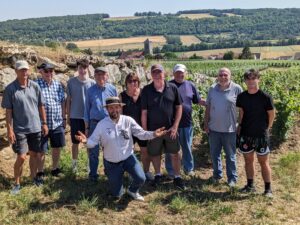
A champagne tasting added a cultural element that all enjoyed!
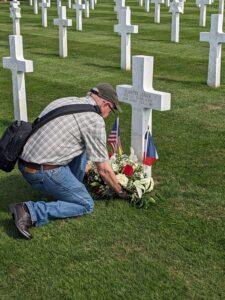
John laying a wreath at his great-uncle’s grave.
Crossing the Rhine River at Boppard, as their father did in early 1945
Review #1: “This week has been a dream come true for me, thanks to the meticulous preparation and execution of the two of you. I truly felt as if I was walking in the footsteps of my grand-uncle in WWI and my dad in WWII, seeing what each of them was seeing and trying to imagine what each of them might have been thinking and feeling during their respective wartime experiences. I couldn’t have asked for a more meaningful experience and the way the two of you embraced my entire family made the experience even more magical and memorable for me. I can’t thank you enough.” John Decker
Review #2:“You have both far exceeded my expectations on this trip. I have been on many tours all over the world and know how they should be done and you two have surpassed them all. The time you both put in to personalize the trip details was extraordinary. The most thrilling part for me was sharing this experience with ALL of my brothers. We have never traveled like this all together and I was not sure how that would work out. Thanks to you two it was fabulous. And to have Aidan and my grandson Jake as part of this is a thrill of a lifetime They will never forget this experience. Thank You!” Bill Decker
Case 2: Carden Family Tour with Surprise Ending, 2026
Note: The text and photos below are from a Facebook Post by KDIH guide, Graham Gaulke, dated 9 July 2026.
At the end of June, I had the enormous honor to guide four family members in the footsteps of Pvt. Wallace Carden, a GI in the 28th Infantry and one of 350 US POWs sent to the Berga/Elster labor camp in early 1945. Wallace’s grandson, Will, reached out to Knee Deep Into History back in January to visit the sites of his grandfather’s captivity, for a one-day tour at the tail end of their family vacation.
Captured during the Battle of the Bulge, Carden was among 350 American POWs transferred in mid-February 1945 from Stalag IXB in Bad Orb to Berga/Elster in Thuringia for hard labor (more on that below). As the story goes, the Stalag leadership was given a quota for 350 Jewish-Americans for the transport to Berga; when only around 80 Jews were found among the GIs, the group was filled in with those who ‘looked Jewish’, were seen as troublemakers, or- for many- simply chosen at random.
Berga was a highly unusual circumstance for the GIs. Back in November 1944, a joint venture between the SS construction department and the so-called “Geilenberg Staff” began work on a giant tunnel system in a nearby valley. Codenamed “Schwalbe 5”, 18 tunnels were dug into the hillside with plans to house a synthetic jet fuel refinery, safe from Allied bombing raids. Under the supervision of German civilian miners, the primary labor force initially consisted of between 1,000 and 2,000 concentration camp inmates from Buchenwald, the majority of whom (but not all) were Hungarian Jews, and who suffered a tremendously high death rate.
When the American POWs arrived in February, they were immediately assigned tunneling work. While the Buchenwald prisoners worked in 12 hour shifts (mostly performing surface deforestation and ‘Transport’ work, such as pushing minecarts and unloading freight wagons) the Americans worked for 8 hours underground in the tunnels, drilling and blasting into the mountain. The GIs were still technically under administration of the Stalag system (and were not, as some erroneously claim, transferred to the SS camp system), but suffered abuses by their army guards and civilian foreman unheard of for Anglo-American POWs elsewhere. In less than three months, 22 GIs died from the results of labor, neglect, and abuse.
With the US army rapidly approaching, in early April the GIs were sent on a death march southwards, covering nearly 250 kilometers on foot over the next two and a half weeks. Along the way, dozens POWs who were unable to continue either died or were left behind; most notably, around 30 of them were left in a makeshift German field hospital in the village of Fuchsmuehl, as a result of negotiations between their guards and local authorities. The remaining 169 POWs- including Wallace Carden- were finally liberated by the 11th Armored in Roetz, on April 23rd. Seventy of the 350 ultimately died of exhaustion, malnutrition, and violence; Carden himself had lost 75 pounds over four months of captivity.
For the Cardens, the places visited carried great personal significance. I’ve dealt with Berga before (albeit largely from the perspective of the Buchenwald system, rather than the GIs) and already had a solid overview of the remains of Schwalbe; Wallace’s memoirs, however, allowed a much more personalized tour than I’d imagined possible. For one, the very tunnel he was assigned to dig, #17, just so happens to be one of the two still accessible today (for those who are particularly adventurous, that is).
Emotional Ending
Most incredibly, however, was a chance encounter in Roetz. While walking around the exterior of the barn the GIs were finally liberated in, we were approached by the farmer, the father and grandfather of whom were the owners during the war. After a bit of explaining why we were there, he eagerly showed us around, opening up the barn and offering a bit of his father’s testimony from the time, including the hen house where the last of the GIs succumbed shortly before liberation. The (long) day thus ended with an emotional moment between Wallace Carden’s son and grandson and the son of the farmer whose barn he was freed in. All in all, a fantastic and incredibly fulfilling experience, despite being the hottest day of the year so far.
Note: It was not chance, rather it was Graham’s in-depth research that identified the death march route and the barn where the death march ended, leading to such an emotional ending. Well done, Graham!
Son and daughter-in-law of Pvt. Wallace Cardin in the tunnel where their father was a forced laborer
Carden Family members walking up the hill to a cemetery
Emotional Ending: Meeting the German farmer in whose barn Pvt. Wallace’s death march ended
Case 3: Yankee Division CT State Library Tour, 2023
We worked with Connecticut historian Christine Glidden Pittsley to design a WW1 Yankee Division Tour that would be a fundraiser for the Connecticut State Library’s Digging Into History Program. The tour was timed to participate in the April 2023 rededication of the Seicheprey Fountain, which, in 1923, had been donated by the State of Connecticut to the badly destroyed town of Seicheprey. The tour included four members of the Second Company Governor’s Horse Guard, who were interested in seeing where their predecessors fought and fell, fighting in the Yankee Division. We nailed it! We also raised $3,100 for the Digging Into History Program!!
Participant Karen Z. reading the last letter her doughboy relative wrote before his death
Members of the Second Company Governor’s Horse Guard and others posing at the Seicheprey Fountain
Grave rubbings made to honor the fallen of the Second Company Governor’s Horse Guard
Review #1:“Randy and Markus, on behalf of the men, women and horses of the Second Company Governor’s Horse Guard we can’t thank you enough for your professionalism, organization and friendship on this tour. Being able to walk in the footsteps of our unit and men during the Great War has been a tremendous experience. However, visiting the cemeteries and honoring our fallen has been very emotional and the highlight of this journey. With kindest regards and admiration, Cpt. Paul Mazzara, Lt. Col. Steven L. de Friesse, 1LT Barbara Srpremullo, LTC Gordon Johnson.”
Review #2:“Dear Randy and Markus, what a well-conceived and well-managed expedition… There were many highlights–places I have long wanted to see; memorable cemetery visits and wreath-layings; a feeling for rural France. The group worked well together and enjoyed each other and you were catalysts to just the right degree. Merci beaucoup! and I hope to be able to travel with you again.” Andy German
(Note: Andy has traveled with us on three tours and hired us for a two-day private tour as of August 2026!)
Case 4: 65th Inf. Div. “Right to be Proud” Tour, 2025
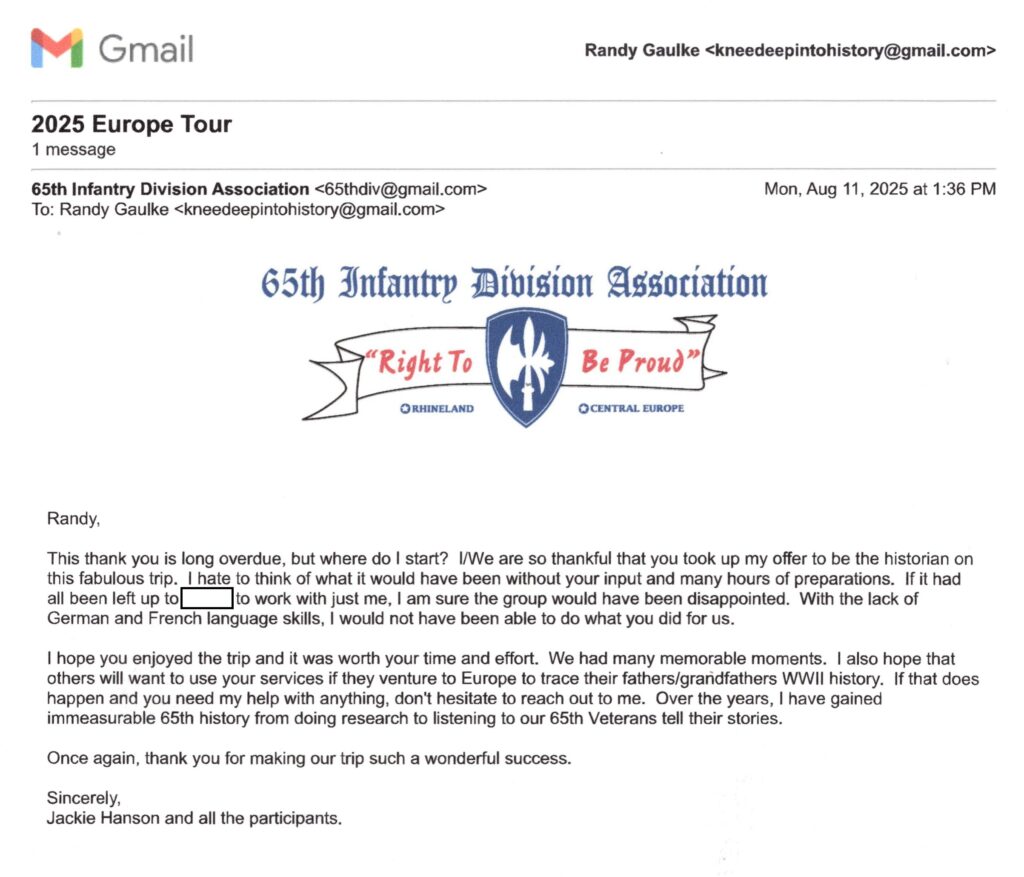
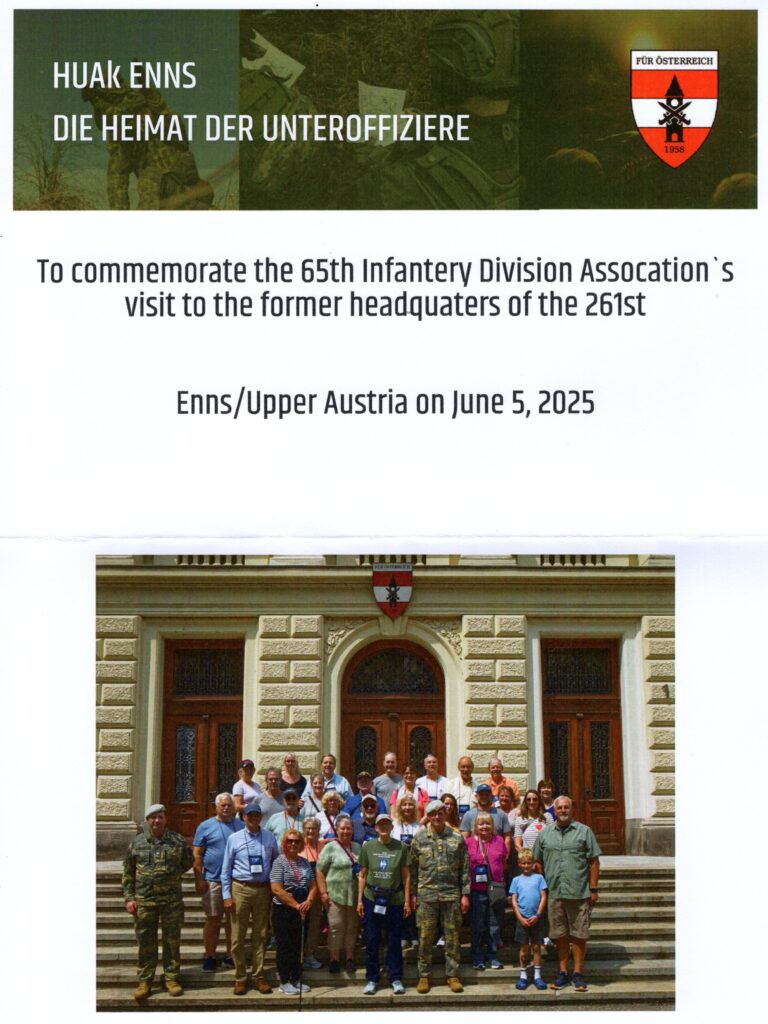
In May/June 2025 I accompanied the 65th Infantry Division Association as the historian on their “Right to be Proud” Tour. The Association was already working with a tour operator when I entered late in the planning stages. After joining the project, I worked with the Association and its tour operator to modify the itinerary to arrange commemorations and meet-ups with various European towns and associations that were of significance to the GIs of the 65th Infantry Division. Here’s the thank you letter I received from the Association and a few photos from those cultural events. It was a real honor and a challene to enhance their tour, but it paid off!
Meeting locals at Ennery, France, where Gen. Patton addressed the Division